Wednesday, October 27, 2010

Election Day Tools

If you are in the United States and not dead, it's kind of hard to miss all the chaos leading up to election day next week. Surprisingly, not a lot of people seem to know where their voting place is or even if they are registered to vote.

Conveniently, Google has made a gadget available for you to drop onto your site to help give people the kind of self-service they need. If you are a web builder (I assume that some of you reading this are), then you can customize the Google Election Center App and grab the code to drop it on your own site to help random voters (even if you are using a limited CMS, the code should still do the trick). As long as users enter a valid address (the example address above is a business address, so it won't return any results), they will see the polling place in Google Maps and directions to get there from the submitted address. In addition, a list of election candidates is provided (in random order).

If the app looks familiar, it's also living on the home page of the Voting Information Project, and the data it uses comes from that very organization.

As a little extra motivation to exercise a right guaranteed to you in the United States Constitution, for which so many have fought and/or died to retain and extend to all citizens, which makes you kind of an ungrateful jerk if you don't vote, Foursquare is offering badges for people who check in to polling places. Read up in this post on Mashable: This Year, Civic Participation Gets You an "I Voted" Foursquare Badge. On November 2 you can wander over to Foursquare's tracking page to see how people across the country are doing (provided they check in).

If you are still wondering who gets your vote and you are far too lazy to do your own research and track down your own unbiased resources, then a Mashable guest writer has provided 17 Web Resources to Help You Decide on Election Day. I suggest you don't wait until election day to decide.

Foursquare Election Day 2010 Badge

Friday, October 15, 2010

Frivolous Patents on the Web

Seal of the USPTOThe history of the web is littered with unexpected patent claims that feel frivolous to nearly all. These are driven partly by a terrible system for reviewing and awarding patents and a litigious society that sustains a business model of lawsuits in the hopes that some will just pay.

The latest example involves a company called Webvention attempting to claim an $80,000 license fee from Novartis for using hyperlinked rollover images on a web site. To be clear, this isn't exactly a new idea. And the patent itself is painfully general. Because Webvention went for a large company, that company has the resources to fight it. Read the full article at ars technica: Rollover image on your website? That will be $80,000 (please)

A History of Frivolity

If you are new to the web, perhaps you didn't know about about other patent infringement lawsuits — ones that others have long since forgotten. For a little context I've included information about a few (this is not an exhaustive list) so you can see for yourself that the trend isn't dying, but the lawsuits aren't holding up. In short, you probably don't need to worry.

Unisys GIF Patent

Way back in the early days of the web, Unisys attempted to assert its claim to the LZW compression method used in the GIF iamge file format, at the time the most popular format on the early web and online providers. Ultimately this led to the development of the PNG format which, while a compelling format, doesn't have the footprint on the web that GIF has, even nearly a decade on.

Overture Search

Overture went after Google and other search engines under the claim the keyword bidding model used for paid search engine placement was a violation of Overture's search patent. This "business method patent," as they have come to be known have included others like the Amazon 1-click ordering process.

British Telecom and Hyperlinks

British Telecom went after ISPs by looking for license fees for hosting web pages that contained hyperlinks. Prodigy successfully fended off the lawsuit, probably in part by pointing out a hypertext system dating back to 1962.

Eolas Targets Plug-ins

The University of California apparently came up with the concept of browser plug-ins, sold the license to that patent to Eolas, and Eolas turned around and sued Microsoft for patent infringement. Plug-in manufacturers quickly started offering workarounds to the way plug-ins are embedded. The developer community was in such an uproar that the W3C even formed an advisory group to address it. Once the USPTO issued a rejection of all claims, the W3C folded up the group and Microsoft was not required to make any changes.

Images as Hyperlinks

Apparently convinced their approach is vastly different from what British Telecom tried to enforce, Singapore-based Vuestar has been invoicing companies for using images as hyperlinks, a violation of its patent. Given that the patent was filed in 2001, there is about a decade of prior art that makes this about as frivolous as they come.

How This Affects Progress

When you look at even this abbreviated history, it's easy to understand why the video codec H.264, initially considered to be the next standard for web video, has undergone such an assault of late. Because the patents for H.264 are held by the MPEG-LA consortium, and because the browser makers are taking different approaches to implementing it based on license fears, it has been dumped from the HTML5 specification. HTML5 is now silent on codecs for video and audio elements. Take a few minutes to read up...

Tuesday, October 12, 2010

IE Below 50%, But Not Universally

Internet Explorer logo

Perhaps you've seen the news, read the tweets, heard web developers shouting from rooftops (which is a heck of climb from the caves in which they are usually kept) — Microsoft Internet Explorer, the browser that has caused developers so much strife, has dropped below 50% market share. It's looking like 1998 all over again.

Catch up on the headlines:

There has been some good that has come out of this. Internet Explorer 9 (beta) has been pushing hard to speed up its scripting engine and better support existing and emerging web standards. This has been primarily due to the competition (and shaming) from Chrome, Safari and Opera. As we see the features, speed, and even interfaces of each new generation of browser start to match one another, developers and users will have a far more level playing field. This is assuming, of course, that trend continues and we don't see the Balkanization of the web again.

Despite all this, I am writing this post as a caution to developers. Already, many have been commenting on how great it will be to dump support for Internet Explorer altogether. Many developers seem to think that we are at that point now. Except we aren't. 50% isn't some magic number to drop support, especially not when developers often build features for the browsers that have far less market share (Safari, Chrome).

This blog only sees 14% of its traffic come from Internet Explorer, which doesn't surprise me given the subject matter. My professional site, which is at the primary domain used by this blog, has double that at 29%. In a vacuum, the much-publicized numbers seem quite real. However, as I review the logs of client sites, I can see a pretty simple trend. Clients whose primary business is B2B are trending between 60% and 80%, with some outliers in the 90% range, for Internet Explorer use. B2C sites enjoy lower IE numbers, hovering around 50-60%.

Remember that the B2B sites are probably visited by users in closed corporate environments where Internet Explorer is mandated. For many very valid reasons, IE has just stuck in that world and will probably continue to do so. Those same users may very well use another browser at home. We need to be careful that we are not excluding those users who either have no choice but to use IE or who aren't techs that can just swap browsers as it suits them.

To be clear: Don't drop your support for Internet Explorer. Make sure you still include it in your testing plan and have provisions for users who visit with IE — even if the experience isn't ideal.

Related

Monday, October 11, 2010

Libya's Terror Plot: Link Rot (Linkpocalypse?)

Vb.ly screen shot.

This is somewhat old news now (it's 5 days old — an eternity) but I think it bears mentioning. The URL shortener Vb.ly was shut down by the Libyan government when it seized control of the domain Vb.ly. The Libyan government runs Nic.ly, the registrar for all things Libyan. Nic.ly informed the owners of Vb.ly that because their shortener is aimed at shortening adult (porn) URLs, the service is in violation of Libyan law, based on Sharia law, that forbids adult content.

There is debate between the Vb.ly owners and Nic.ly, primarily because Vb.ly owners claim they had just been allowed to renew the domain, do not host any adult content, and never received any warnings of any violations. Nic.ly claims its partner had attempted to contact the owners ov Vb.ly on many occasions and feels that Vb.ly's adult theme (citing a photo of a woman on the front page with bare arms) is a violation of Libyan law. Interestingly, on June 1, Nic.ly issued a statement saying it would no longer sell domains shorter than 4 characters to non-Libyans, but existing customers could keep their short domains. There is plenty of debate here about whether Nic.ly is taking advantage of this opportunity to grab the Vb.ly domain for its own use. I strongly suggest you read the coverage:

Why Does This Matter?

We've all seen URL shorteners climb to the fore thanks to services like Twitter. Web developers' and content authors' fascination with long URLs means that a page address is often too long to fit into a tweet, let alone the back of a business card. Shotening a URL to just a few characters has become so commonplace that it is expected nowadays even in the mundane world of print. Gone are the days when you would have to come up with a brief page address/redirection for a campaign, now we can see advertisements with Bit.ly URLs, as well as those driven by other services. Google has Goo.gl, YouTube has YouTu.be, other companies have tried to get variations on their company names so they have control over their brand and, ultimately, all those links. And then there is Bit.ly.

Bit.ly is the largest of the .ly shortener services, but not the only one. Owl.ly and 3.ly come to mind. They are all at risk of seeing their core feature pulled. Because we have all come to rely on these shorteners so extensively, entire collections of links (blogrolls, tweet archives, advertising campaigns) can come to a crashing halt should these shorteners be pulled.

While all this develops, I still echo my concern about URL obfuscation and link rot. It's too easy to hide the true destination of a link when you mask it using a shortener. While I previously worried that link rot would manifest into links to porn/scam sites as the shorteners went out of business and had their assets bought up, I now wonder if the .ly shorteners will be seized and directed to Libyan government materials instead. Either way, the link rot I had feared from the over-use of shorteners seems heightened now that Libya has demonstrated that it can just take a domain back, possibly setting the stage for other countries with questionable motives.

To re-repeat previous posts on this topic, we are approaching 2012. The End of Days the Mayans predicted could be starting now in the form of link rot, catalyzed by Libya, and leading to Linkpocalypse.

Related:

Note: In case you don't get it, the terror and apocalypse references are over-stated on purpose. I don't truly think the world will end if Bit.ly or the others go away. At worst, it will be annoying and make all my bookmarked tweets useless. I am taking license with the themes because it's an opportunity to remind people that shorteners are not always a good idea.

Wednesday, October 6, 2010

Humorous Social Media Infographics

Sometimes the best way to get the point across is with humor. A couple posts in the last couple of days are doing just that and exposing a little about how people use Facebook along with the current social media landscape.

Facebook Portraits

Facebook Portraits

A comic / writer / designer put together this flowchart Fast Company Design in the article Infographic of the Day: A Flowchart of Facebook Portrait Styles. The article dissects the Facebook profile photo to provide insight into the personality of the profilee. All of this is nicely woven with a flowchart outlining the most common types of photos (the Self-Shot, Using Mirror, Bathroom, Dead Robot Eyes path strikes a little close to home on profiles of folks who sorta-stalked me). I have used all four levels of zoom, if anyone cares.

The Social Media Landscape

Map of Online Communities

The cultish online comic xkcd has a new version of its Map of Online Communities today. Unlike previous comics on this theme (see xkcd's original map, followed by Flowtown's capitalizing-on-someone-else's-idea version), this one is far more detailed and includes some explanation for its modeling, probably owing to how broadly this has been shared across the social media world. If you don't believe me, Mashable was all over it this morning, and clearly so am I (although I started this post before I saw Mashable's post, so I'm not a big fat copycat). We can see that my blog would probably be on the shores of the Sea of Opinions in the region of Blogosphere in the Tech Blogs peninsula. Maybe I'm just renting a flat on the border of Gizmodo?

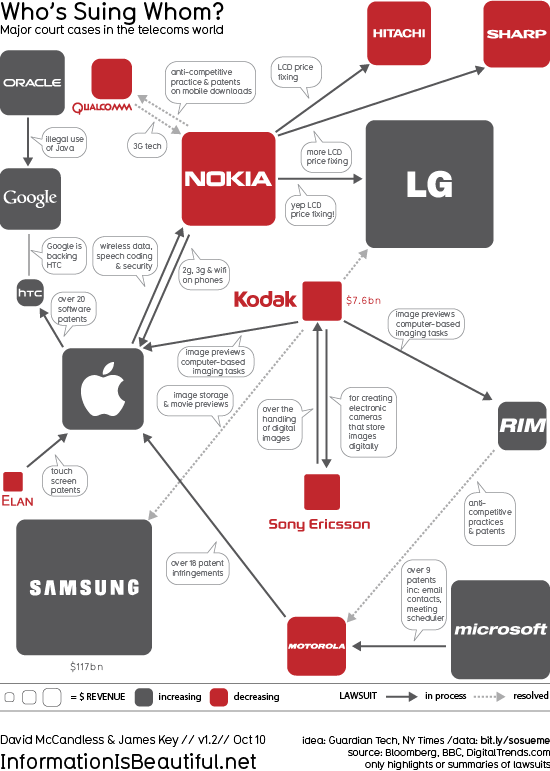
Mobile Lawsuits

Who's suing who in the mobile business

This isn't keeping in line with social media, but is keeping in line with humorous imagery to explain concepts that themselves might be absurd. The Guardian covers who's suing who in the mobile space in this nice graphic in the post Microsoft sues Motorola over Android – and all the other mobile lawsuits, visually. The graphic simply illustrates how much of a mess it is out there as each company tries to assert some claim to what is clearly becoming the place to be.

Update: Oct 8, 4:52pm EST

Who's Suing Whom?

Not to be outdone, and motivated by the New York Times article/graphic and the Guardian article/graphic (above, although you should follow the link because the graphic has been updated), Information is Beautiful came up with its own infographic in the post Who's Suing Whom In The Telecoms Trade?.

Monday, September 27, 2010

Targeting the Mobile Web

Image of mobile phone showing this site.Given the rise of mobile computing on phones and pads, web developers can no longer think of the sites they develop as living in the world of the desktop browser. Thankfully, things are much easier than they used to be. Developers no longer need to focus on arcane reformulations of specs wrapped in TLAs like WML, but are now free to utilize current technologies with a lot less agony — if they do it right. To that end, the following presenters outline some best practices for web developers as they bring their talent to the mobile web.

Andreas Bovens

Andreas Bovens led a mobile web development workshop in July at the Mobile 2.0 Conference in Barcelona. Since I couldn't attend, and something tells me neither could you, he has provided his presentation as an 18 minute screencast. In it, he outlines three approaches to mobile web development:

  1. Do nothing: For the most part, this works fine in modern mobile browsers. Liquid layouts tend to work best.
  2. Create a separate mobile site: Rely on user agent detection to shunt users to one or the other site while still offering a link to override.
  3. Create one site that works for all: Let one site adjust its layout for different devices.

The use of the viewport meta tag is covered along with media queries. Watch the video to see all the details.

Bruce Lawson

Bruce Lawson presented on the broader topic of web development in the new world of HTML5, CSS3, mobile, and all the things that come along with those new standards and technologies. He has posted his Over the Air 2010 talk along with a great list of reference links.

Sadly, the Slideshare doesn't work on that page, but you can view it below. Jump to slide 42 for the information on the mobile web.

Bryan Rieger

In this presentation we see a simple argument espoused by Luke Wroblewski, among many others, which is to design for mobile first (Luke Wroblewski on Mobile First). Start with the mobile platform, and then add in support for desktop browsers, building the site up instead of tearing things off. A simple concept that not everyone seems to understand.

You can see some of the same points in this set of slides, with a focus on the trends instead technical implementation discussions. This one is handy for explaining the rise of mobile to non-developers.

Tim Berners-Lee

Widely credited with inventing the world wide web, having Tim Berners-Lee weigh in on developments in mobile computing certainly adds an interesting perspective on these trends. At Nokia World 2010, Tim Berners-Lee detailed four concerns about the future of the mobile web:

  1. Privacy: Specifically discussing location-aware devices, he thinks we might all have to adjust how we think about privacy as a core concept.
  2. Accountability: As companies learn about us more and more, including our location, we need to have methods in place to ensure they aren't abusing our data.
  3. Neutrality: Net neutrality is a topic he discusses a lot, and this is a great opportunity for him to argue that net neutrality should exist for all web platforms.
  4. Access: With so much of the world unable to afford computers or mobile data plans, sites need to be diligent about smaller pages and low cost data plans need to be developed.

How his concerns will bear out, along with the technical implementation techniques outlined above, will be quite interesting to watch in the near and far future. If you are a web developer, you should be asking if you'll be helping or hindering.

Thursday, September 23, 2010

Buffalo Launches Social Media Club Chapter

Social Media Club Last night marked the official kick-off of the local chapter of the Social Media Club. If you haven't ever heard of Social Media Club, you should take a few minutes to visit its site and familiarize yourself. Failing that, here is Social Media Club's mission:

Social Media Club's mission is to connect media makers from around the world to advance media literacy, promote industry standards, encourage ethical behaviour and share the lessons they have learned.

In short, the social media club is the professional organization for a new industry. Just like there is an American Advertising Federation for agency professionals, and Legal Marketing Association for legal marketing professionals, Social Media Club is taking a similar role for professionals in the world of social media. With a speaker directory, education programs, regular events, and all the other benefits you might expect from a professional organization, it is becoming a resource for those in the industry and those looking for help.

Buffalo has a healthy supply of social media professionals and advocates, along with people who are being dragged or pushed into that responsibility (just like any industry). Given the success of the first social media meetup on June 30, and then its successor on July 27, it was pretty clear that Buffalo had an interest and a need for a professional support community.

And so began the planning and ultimately formation of the Buffalo Social Media Club chapter. And to bring that back 'round to the beginning, last night was the kick-off event to welcome new members, prospective members, and the curious. Unlike previous social media events, this one saw a lot less tweeting on the fly as people took some time to get to know each other and talk about how they use social media professionally or casually.

The Buffalo News covered the event and wrote up a story: New club aims to help enthusiasts learn how to cash in on social networking. From the article:

Nicole Schuman, president and co-founder of Social Media Club Buffalo, said the club is open to all kinds of savvy users of online social media outlets, like Kin, whether they’re media professionals who use Facebook and LinkedIn to enhance their business connections or simply new social media enthusiasts.

"This event itself was only advertised through Facebook, Twitter, Foursquare [and] LinkedIn. We’re going to have over 100 attendees in the area just because people passed along the information to one another. It’s just a new word-of-mouth," Schuman said.

Skunkpost also showed up and interviewed some attendees. While I managed to dodge the camera (by hiding behind my own), you can see my tweets at 0:51, sandwiched between interviews with guys with hair:

Given how dark the venue was, it may be some time before I have my photos posted. Until then, enjoy this dark photo from my phone showing off some food and watch for the photos later.

Learn More...